
County council opposes southern ALTO route
By Cecilia Nasmith
Northumberland County council voiced strong opposition to a proposed southern route for the ALTO high-speed rail project.
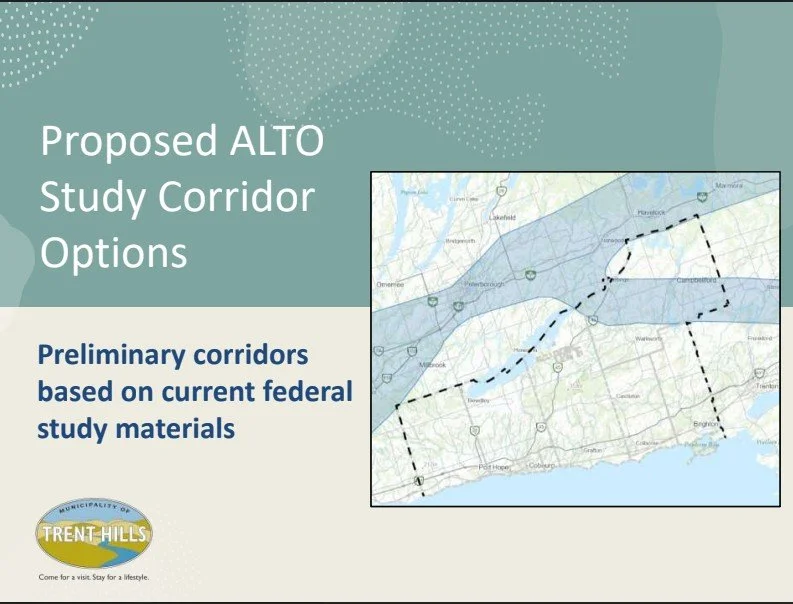
The opposition was not limited to county council - Trent Hills Deputy Mayor Michael Metcalf addressed Wednesday's meeting representing his own council and their concern over the “significant and direct” impacts on their municipality.
The northern route has been known for some time, Metcalf said. The southern route only showed up in January, apparently when Kingston began lobbying for a stop.
The potential southern corridor impacts Hastings and Campbellford, two of their three significant urban settlements, as well as established infrastructure networks and prime agricultural land – at a time when as-yet-not-updated data from 2021 suggest Ontario is losing at least 319 acres of farmland every day.
Then there's the on-going uncertainty for home owners, community members, businesses and investors.
“There hasn't been a lot of forthcoming information from the Federal government on this subject, the final route is not yet selected,” he added.
“For us, this isn't speculative. It's something we are actively responding to.”
The ALTO representative they spoke with could not produce a needs study. The Federal representative they spoke with could not provide population projections.
Though the impacts on his municipality are “significant and disproportionate,” Metcalf asked for the backing of the county to take a strong and united position in opposition to the southern route.
Several councillors noted that there are alternatives,
Olena Hankivsk expressed her hopes for a strengthened transportation infrastructure, as the VIA commuter train has proven not to meet many people's needs and they remain dependent on automotive transporation.
“I don't think I would oppose a southern route that ran across the existing lakeshore line, provided it also came with infrastructure money for over- and underpasses,” Brian Ostrander said – adding that “We should oppose the existing southern route as it stands”
John Logel suggested using the Highway 401 corridor with its existing infrastructure, with which Deputy Warden Mandy Martin agreed.
Martin spoke of an uneasy relationship between Canadians and their rail service.
“We are held hostage by rail lines. Who's the governance on this, because it doesn't bode well given the past history, which is why I support the 401 corridor, which is at least under the province's control,” she said.
“It just concerns me we don't know who runs the shop, who's proposing it, where the money is coming from.
“The agricultural lands we have is the last – we don't have any more coming,” she noted.
“The fact that in January it came up because Kingston wanted a stop – what do you want, a casino? Let's put in our wish list now and see what happens.”
Martin pointed out that the Eastern Ontario Wardens Caucus has said they support not going with the southern route, “and I think that's significant. That's all the wardens in Eastern Ontario, that says something to me.”
“When we have no details, no collaboration, no understanding – it's absolutely nuts.”
Council voted support of the EOWC letter stating that position and, later in the meeting, received a staff report on the matter from Director of Economic Development and Tourism Dwayne Campbell, which echoed many of the comments made. Council voted to provide the report as its input in the consultation process (which ends April 24) and to state its opposition to the southern route.
The motion also incorporated the comments from Hankivsky and Ostrander, asking that consideration be given to strengthening alternate the existing transportation corridor and supporting alternative transportation options,