
Local town crier describes world event
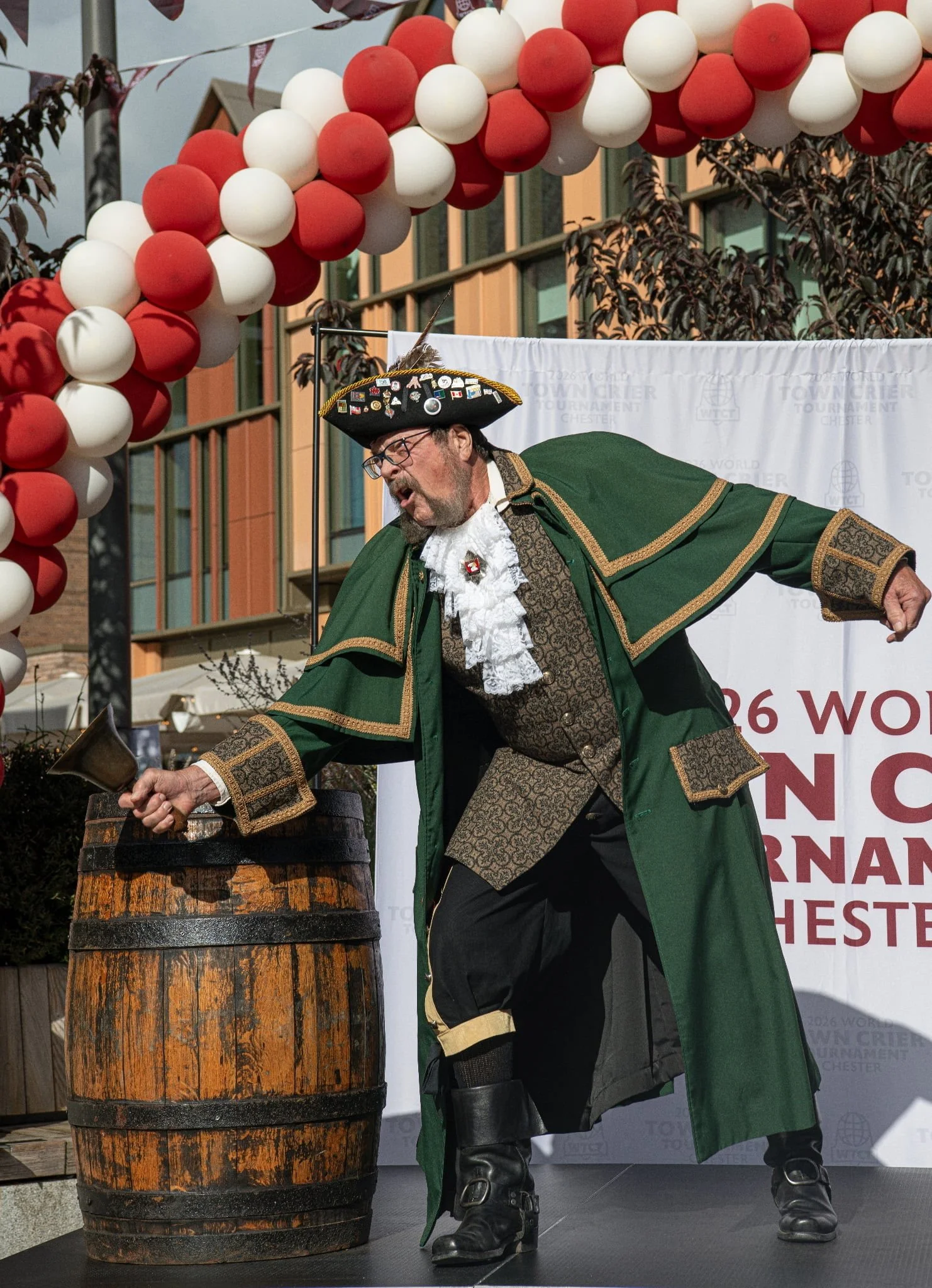
Photo submitted.
By Cecilia Nasmith
Liam Cragg stepped out of the kitchen at St. George's Anglican Church, having shed his apron to don his full town crier's livery, to address about 50 people Friday on his experiences at last month's World Town Crier championships in Chester, England.
The official town crier for Alnwick-Haldimand Township, Cragg doubles – or is it triples? - as a Grafton farmer and a member of the Men's Group that serves up breakfast at the church every Friday morning.
“Thank you for coming out to be guinea pigs on my first presentation,” he said.
Cragg called it the chance of a lifetime to hang out with fellow criers from around the world – 10 from the UK, one each from Germany and Belgium, three from the Netherlands and two from Australia, not to mention several Canadians present. The length of experience ranged from decades to one who'd just gotten his appointment in the last year. That was the one from New Brunswick and, in addition to Cragg, the other Canadian criers were from Nova Scotia and Kingston, Ont. (this one happening to be a three-time world champion).
There were also celebrity criers, including one who was the morning radio host of BBC Merseyside in Liverpool. In a tribute to the Beatles, he opened his cry with, “She loves you! Oyez! Oyez! Oyez!”
Other celebrity judges included a mystery writer and an actor who was on Coronation Street for 15 years.
Cragg offered some history behind his craft, saying that the original crier may have been a messenger in 490 BC, who ran 25 miles from Marathon to Athens to announce the victory before collapsing and dying.
In England, bellmen would patrol at night to watch for fires in the thatched rooves. After the great London fire of 1666, many settlements used these bellmen to announce the change to slate rooves – and from there, the town crier tradition began.
They would make their cries and then attach the proclamation to a post in the village square (which is why some newspapers called themselves The Post). Another popular posting place was the door of the closest pub, allowing the crier a handy chance to rehydrate.
Though the tradition is believed to be British, there are also accounts of criers in many nations, including the Lakota Tribe in North America and other tribes in Western Africa.
As people gained the ability to read, the art began declining. But it has not entirely died out, especially in England. While a Canadian crier competition often attracts a crowd no larger than 50, Chester's events attracted as many as 150.
Cragg shared the short video he sent to audition for the competition. As a farmer, he held a chicken in one arm. Though the bird hastily decamped at that first peal from the bell, Cragg was confident that his submission would stand out from the many received.
Once chosen, he was told to fly in full livery in case his luggage was lost. The wisdom of this move was apparent when four criers arrived but their luggage did not (there was much generous sharing of wardrobe items until this problem was corrected).
Asked what it was like to travel in costume, he said, “Not so bad as lining up to get my boarding pass.” Of course, he added, nobody wanted to make eye contact with him.
Not long after he arrived, he was enjoying a stop in a pub 30 years older than the Hudson's Bay charter when a fellow shouted, “I recognize that voice! You were on the plane over.”
Cragg's own livery has custom-made greatcoat and vest, with other pieces from a company in Tampa, Fla. (“which I won't be buying from now”), where there is one of the world's largest pirate festivals. Town criers are often asked why they are dressed like pirates, Cragg said, but perhaps one should ask why pirates dress like town criers.
There were as many different outfits as there were criers, he continued, and every one has a story behind it. The variety was “just spectacular,” he declared.
Besides the competition cries, there were a series of special events, like the parade that began each day. The Nova Scotia crier had been planning to lead the parade, but his bagpipes did not arrive.
Then there was their visit to a seniors home to share a bit about the history of their countries.
Canada officially began with its 1867 Confederation (“which is like five minutes ago to the English”), but its history goes back to the Hudson's Bay Company charter in 1670 and back to the Viking settlements in Newfoundland that date to about 1000 AD.
By contrast, the Roman walls that surround Chester date back to 80 or 90 AD. It's the longest such wall intact in England, and it's about a 3K walk to go around it.
The Town of Dunmow could boast the Fitch Trials, depicted in Chaucer's Canterbury Tales and going back 900 years. The quadrennial competition has couples competing for half of a smoked pig (which is where we get the phrase “bringing home the bacon”). You get eliminated right away if you and your spouse have had an argument in the last year-and-a-day, and eliminations continue until only five couples remain to be examined by a judge. The winner is decided by a jury of six bachelors and six maidens.
One UK crier had no long-standing tradition to share, so he consulted with a group and came up with The Public Shaming of the Neglected Community Garden.
When it came time for the actual cries (in three categories – retail, accommodation and one's home town), judging was done on a number of criteria, including use of humour, engaging the audience, the quality of the writing of the cry. Cragg played clips of his retail cry (which actually contained the word “huzzah”), and his accommodation cry won a silver third-place plate from the celebrity judge of the day.
“Thank you to the township and to the people who supported me. It was an incredible experience. 'Once in a lifetime' doesn't do it justice,” he said.
